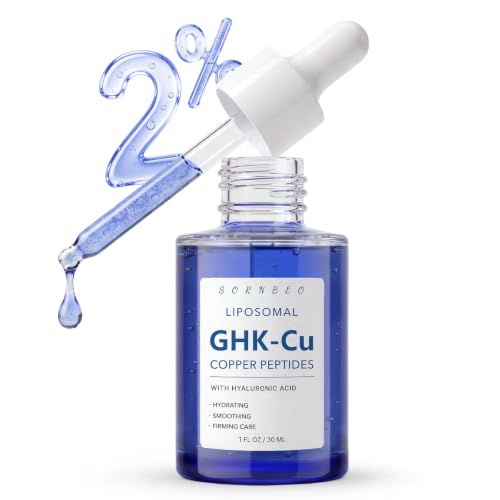
The standard story about copper peptides has a direction of travel built into it. The peptide is the vehicle, copper is the cargo, and the point of the ingredient is to deliver copper where skin can use it. A 2024 paper from Karolinska Institutet studies the same tripeptide with the arrow pointing the other way, treating GHK as the thing that takes copper out of circulation and stops it doing harm. Both descriptions are chemically correct, and holding both at once is the clearest way to understand what this molecule is.
This article covers GHK-Cu as a cosmetic ingredient. It is not medical advice, and nothing here has been evaluated by the FDA.
Key Takeaways
- Uncomplexed GHK binds copper and reduces its redox activity, and prevented copper- and zinc-induced cell death in central nervous system cells in vitro [1].
- GHK also prevented copper- and zinc-induced aggregation of a model protein, and reversed existing aggregation by making the protein soluble again [1].
- Copper toxicity was worse under inflammatory conditions, and GHK reduced it [1]. The authors frame GHK as potentially cytoprotective against copper and zinc toxicity.
- The complex is not permanent. In a skin permeation study copper crossed at about five times the molar amount of the peptide [2].
- On labels, copper tripeptide-1 means the complex and tripeptide-1 alone means the peptide without copper. The distinction is real and easy to miss.
Two Names, Two Different Molecules
Start with the label, because this is the part that changes a purchase. Copper tripeptide-1 is the copper complex: GHK bound to a copper ion. Tripeptide-1, listed with no copper prefix, is the peptide alone.
They are chemically related in the most direct way possible, one being the metal complex of the other, and they are not the same ingredient. A product listing tripeptide-1 is not a copper peptide product, whatever the surrounding marketing says.
What the Uncomplexed Peptide Actually Did
The Karolinska group set out from neurodegeneration rather than skincare [1]. Their starting observation is that copper and zinc, uniquely among common metal ions, strongly promote protein misfolding and clumping, and that free metal in excess contributes to cell death.
Working in vitro, they showed that GHK binds copper and reduces its redox activity, which is the chemical way of saying it holds the metal in a state where it is much less able to generate damaging free radicals. Downstream of that, GHK prevented copper- and zinc-induced death of central nervous system cells [1].

The protein result is the more striking one. GHK prevented copper- and zinc-induced aggregation of bovine serum albumin, a standard model protein, and went further by reversing existing aggregation, resolubilising protein that had already clumped. They also showed that copper is more toxic under inflammatory conditions and that GHK attenuates that, and that GHK is protective against copper-enhanced paraquat toxicity [1].
Their conclusion is that GHK has potential as a cytoprotective compound with respect to copper and zinc toxicity, worth further investigation for neurodegenerative disease [1]. Note the framing carefully: the peptide is the protective agent and copper is the hazard.
Why Both Framings Are True
There is no contradiction between “copper peptide delivers copper” and “GHK protects against copper”. They are two consequences of the same chemistry.
GHK has a strong affinity for copper ions. That affinity is why the complex forms readily, why the complex is stable enough to put in a bottle, and why copper bound to GHK behaves very differently from a free copper ion in solution. Free copper is a reactive, redox-active metal that will happily participate in chemistry you do not want happening in tissue. Copper held by GHK is chaperoned.
This is a large and underappreciated part of why copper peptides are tolerable as a cosmetic ingredient at all. The complex is not simply a copper delivery device; it is copper in a controlled form, which is precisely what makes it usable [3].
The Complex Does Not Stay Together
One measured result puts a limit on how far the delivery-vehicle picture should be pushed. In the study that used microneedle pretreatment to get GHK-Cu through human skin, the amounts that crossed were 134 nanomoles of peptide and 705 nanomoles of copper over nine hours [2].

Those are molar quantities. In a one-to-one complex travelling intact they would be similar. Copper crossed at roughly five times the molar amount of the peptide, which means copper separates from the peptide and moves independently, and faster.
Combine that with the Karolinska work and a more accurate picture emerges. What you apply is a complex. What moves is partly the complex and substantially copper on its own. And the peptide portion has its own copper-handling behaviour [1] independent of whatever cargo it arrived with.
What This Changes in Practice
Read the ingredient name properly. Copper tripeptide-1 and tripeptide-1 are not interchangeable. If you are specifically buying a copper peptide product, the copper prefix is not decoration.
Be sceptical of both extremes. The claim that copper peptides flood your skin with beneficial copper and the claim that they strip copper out of it are both overstatements of what has been shown. The evidence supports something narrower and less dramatic: strong copper binding, reduced copper reactivity, and a complex that partially separates in transit [1][2].
Do not extrapolate the neuro work. This was cell culture, aimed at neurodegeneration, with no skin endpoint and no topical arm. It changes how you understand the chemistry. It is not a reason to expect anything new from a serum, and the delivery constraints on topical GHK are unchanged [4].

Frequently Asked Questions
Is tripeptide-1 on an ingredient list the same as copper tripeptide-1?
No. Copper tripeptide-1 is the copper complex, GHK-Cu. Tripeptide-1 with no copper prefix is the uncomplexed peptide, GHK. They are related but they are not interchangeable, and a product listing only tripeptide-1 is not a copper peptide product.

Does GHK do anything without copper?
Yes, and in one respect the uncomplexed peptide is the more interesting molecule. A Karolinska group showed that GHK binds copper, reduces its redox activity, and prevents copper- and zinc-induced cell death in nervous system cells in vitro [1]. It also prevented and reversed metal-induced protein clumping.
If GHK binds copper, does it strip copper out of my skin?
That question has not been tested in skin and should not be answered from the in vitro work. What that work supports is narrower: GHK has a strong affinity for copper, and copper bound to GHK is less able to drive damaging redox chemistry than free copper is [1].
Why does the complex matter at all then?
Copper is what makes the molecule biologically distinctive, and holding it in a controlled form is much of why the complex is well tolerated rather than pro-oxidant. But the complex is not permanent. In a skin permeation study, copper crossed at roughly five times the molar amount of the peptide [2], which means the two parts can separate.
References
- Min JH, Sarlus H, Harris RA. Glycyl-L-Histidyl-L-Lysine Prevents Copper- and Zinc-Induced Protein Aggregation and Central Nervous System Cell Death In Vitro. Metallomics (2024). PMID 38599632
- Li H, Low YS, Chong HP, et al. Microneedle-Mediated Delivery of Copper Peptide Through Skin. Pharmaceutical Research (2015). PMID 25690343
- Pickart L, Margolina A. Regenerative and Protective Actions of the GHK-Cu Peptide in the Light of the New Gene Data. International Journal of Molecular Sciences (2018). PMID 29986520 (authors affiliated with Skin Biology, a company that sells copper-peptide products)
- Mortazavi SM, Mohammadi Vadoud SA, Moghimi HR. Topically Applied GHK as an Anti-Wrinkle Peptide: Advantages, Problems and Prospective. BioImpacts (2025). PMID 39963574
These statements have not been evaluated by the FDA. This product is not intended to diagnose, treat, cure, or prevent any disease. This article is for informational purposes only and is not a substitute for professional medical or dermatological advice. As an Amazon Associate we earn from qualifying purchases.
These statements have not been evaluated by the Food and Drug Administration. This information is not intended to diagnose, treat, cure, or prevent any disease. Content is for informational purposes only and is not medical advice; consult a qualified healthcare provider before starting any supplement. As an Amazon Associate we earn from qualifying purchases.