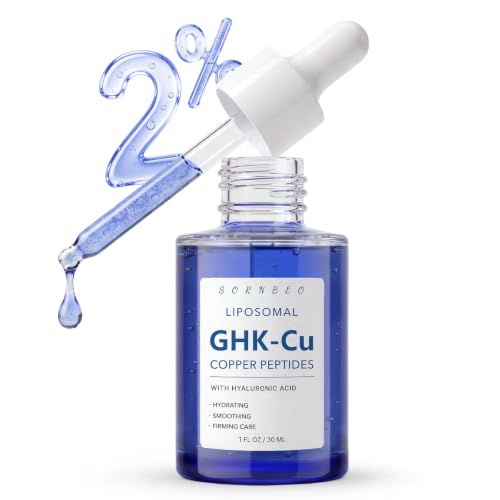
Encapsulation is the answer the copper peptide industry settled on, and liposomes are the version that reached the shelf. They are not the only thing being tried. Three other approaches appear in the recent literature, and reading them together tells you something useful: the delivery problem is being attacked hard, by materials scientists rather than cosmetic chemists, and none of the results have arrived in a bottle you can buy.
This article covers GHK-Cu as a cosmetic ingredient. It is not medical advice, and nothing here has been evaluated by the FDA.
Key Takeaways
- A polyol-modified liposomal nanocarrier slowed GHK-Cu release and protected it from enzymatic degradation, with cell work implicating Nrf2 and SIRT1 signalling [1].
- An ionic liquid microemulsion improved local delivery of copper peptides by roughly three-fold while keeping the peptide functional, validated in mice and aimed at hair loss [2].
- A peptide-gold nanofibre hybrid used GHK as a surface functionalisation for wound healing and near-infrared photothermal therapy [3]. That is a medical device concept, not a serum.
- All three are laboratory systems. None is commercially available, and none has been tested against a marketed copper peptide product.
- The common thread is that stability and permeability, not activity, are the bottleneck for this peptide [4].
Why the Field Keeps Building New Carriers
The case for a carrier is always the same two problems. GHK-Cu is hydrophilic and does not cross an intact stratum corneum well, and it is a short peptide that skin enzymes can take apart. A carrier that solves either one is worth building; a carrier that solves both is worth publishing [4].
Liposomes are the familiar answer. What follows are three that are not.
The Polyol-Modified Nanocarrier
A group at South China University of Technology built a GHK-Cu carrier starting from liposome technology but modifying the phospholipid bilayer with different polyols, described in the paper through a rigidity and flexibility framing [1]. The stated goals were a high loading rate, good stability and biocompatibility.
Two results are worth noting. The system retarded release of the copper peptide, meaning it came out gradually rather than all at once. And it made the peptide resistant to enzymatic degradation, which addresses the second of the two problems directly. Cellular work then reported effects on Nrf2, SIRT1 and prostaglandin and COX-2 related signalling, framed as countering oxidative damage, senescence and apoptosis [1].

The honest reading: this is in vitro and cellular work. There is no human skin permeation number and no clinical arm. One of the authors is affiliated with a biotech company, which is normal in this field and worth knowing.
The Ionic Liquid Microemulsion
The most quantitatively concrete of the three comes from a Harbin Institute of Technology group working on hair loss [2]. Their framing is direct: copper peptides are a promising hair growth agent with a better side effect profile than minoxidil or finasteride, but you cannot get them where they need to go.
They designed an ionic liquid based microemulsion, combining the high solubility that ionic liquids give with the skin permeability that microemulsions give, using phase diagrams and theoretical calculations rather than trial and error. The reported outcome is roughly a three-fold improvement in local delivery of copper peptides while retaining biological function, validated in mice, with effects on vascular endothelial growth factor expression and activation of Wnt and beta-catenin signalling [2].
Take the three-fold figure carefully. It is three times the comparison preparation used in that study, in mouse skin. It is not three times a serum you own, and mouse skin is thinner and more follicle-dense than human skin, which flatters any topical delivery result.
The Gold Nanofibre Hybrid
The third is the furthest from cosmetics. A Korean group built self-assembling peptide nanofibres studded with roughly three-nanometre gold nanoparticles, functionalised with GHK on the surface [3]. Their stated motivation is the same one as everyone else’s: GHK has real therapeutic potential but poor biological stability limits its use.
An interesting structural detail is that the amino acid sequence changed how much lysine ended up exposed at the surface, and that in turn changed wound healing performance. Sequence orientation mattered, not just presence. The resulting material also absorbs near-infrared light well enough to be used for photothermal killing of cancer cells [3].

Nothing in this is a route to a face serum, and it is not offered as one. It is included here because it shows what GHK looks like when engineers rather than formulators get hold of it: the peptide becomes a functional surface group on a device.
What This Means When You Are Buying Something
Three points survive the trip from these papers to a purchase decision.
The bottleneck is real and everyone knows it. Three separate research groups, in three different materials disciplines, all open with the same sentence about GHK-Cu being promising and hard to deliver [1][2][3]. Any marketing that treats penetration as a solved problem is contradicted by the people actually working on it.
None of this is purchasable. If you want an encapsulated copper peptide today, liposomal products exist. Polyol-modified rigid-flexible nanocarriers and ionic liquid microemulsions do not.
Improvement multipliers are relative to a laboratory control. A three-fold gain over a plain solution in mouse skin is a good research result and tells you nothing about how one commercial serum compares to another.

Frequently Asked Questions
Can I buy any of these delivery systems?
No. The polyol-modified nanocarrier, the ionic liquid microemulsion and the peptide-gold nanofibre are all laboratory constructions described in materials science journals [1][2][3]. None of them corresponds to a product on a shelf. Liposomal copper peptide serums do exist commercially; these do not.
The ionic liquid system improved delivery three-fold. Three times what?
Three times the local delivery achieved by the comparison preparation in that study, in mice [2]. It is not three times a commercial serum, and it is not a measurement on human skin. Multipliers reported against a laboratory control do not carry over to whatever you currently use.
Does a product saying nano or encapsulated mean it uses one of these?
Those words are not regulated in a way that tells you anything specific. The systems described here are defined by their construction, and the papers spend most of their length on characterisation for that reason [1][2]. A marketing term on a carton is not a characterisation.
Why is so much of this research aimed at hair rather than wrinkles?
Follicles are a plausible route past the stratum corneum, and the hair loss market tolerates more intervention than the face cream market does. The ionic liquid work is framed against minoxidil and finasteride and reports Wnt signalling and growth factor readouts [2]. That is a drug-development frame, not a cosmetic one.

References
- Wang Y, Lin J, Yu Z, et al. Rigid-Flexible Nanocarriers Loaded With Active Peptides for Antioxidant and Anti-Inflammatory Applications in Skin. Colloids and Surfaces B: Biointerfaces (2024). PMID 38394858
- Liu T, Liu Y, Zhao X, et al. Thermodynamically Stable Ionic Liquid Microemulsions Pioneer Pathways for Topical Delivery and Peptide Application. Bioactive Materials (2024). PMID 38026438
- Jeon N, Kim L, Choi SG, et al. Self-Assembled Peptide-Gold Nanoparticle 1D Nanohybrids Functionalized With GHK Tripeptide for Enhanced Wound-Healing and Photothermal Therapy. ACS Applied Materials and Interfaces (2025). PMID 40019920
- Mortazavi SM, Mohammadi Vadoud SA, Moghimi HR. Topically Applied GHK as an Anti-Wrinkle Peptide: Advantages, Problems and Prospective. BioImpacts (2025). PMID 39963574
These statements have not been evaluated by the FDA. This product is not intended to diagnose, treat, cure, or prevent any disease. This article is for informational purposes only and is not a substitute for professional medical or dermatological advice. As an Amazon Associate we earn from qualifying purchases.
These statements have not been evaluated by the Food and Drug Administration. This information is not intended to diagnose, treat, cure, or prevent any disease. Content is for informational purposes only and is not medical advice; consult a qualified healthcare provider before starting any supplement. As an Amazon Associate we earn from qualifying purchases.